A vital part of contextualising the fossil record well, especially in regard to bipedalism (walking on two legs, bi=two + ped=feet) and associated anatomical changes, is illustrating the connection between humans and other extant (contemporary) primates first. If you establish those connections well, then the hunt for bipedal traits in the fossil record is an intuitive next step!
If our closest living relatives are not bipedal (but we are), then bipedal apes in the fossil record are likely even more related to us than any living apes today. Which is really saying something when bonobos and chimpanzees share 98.7% of our DNA. For context, by the same evidentiary standard, we share about 1% of our DNA with bananas.
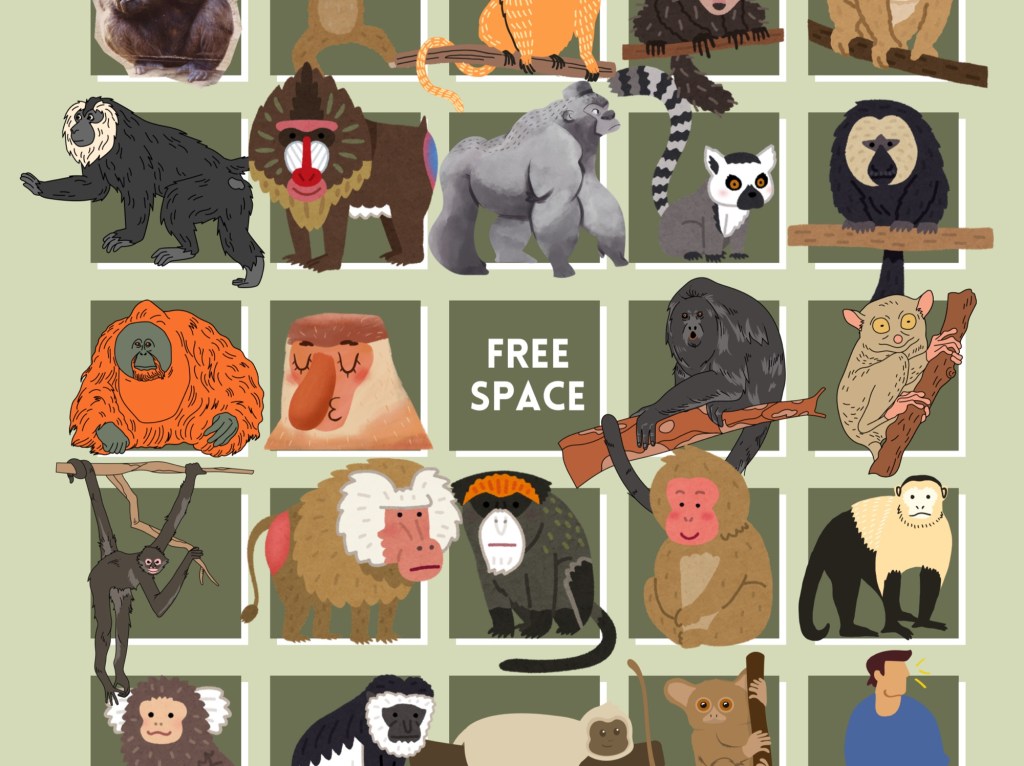
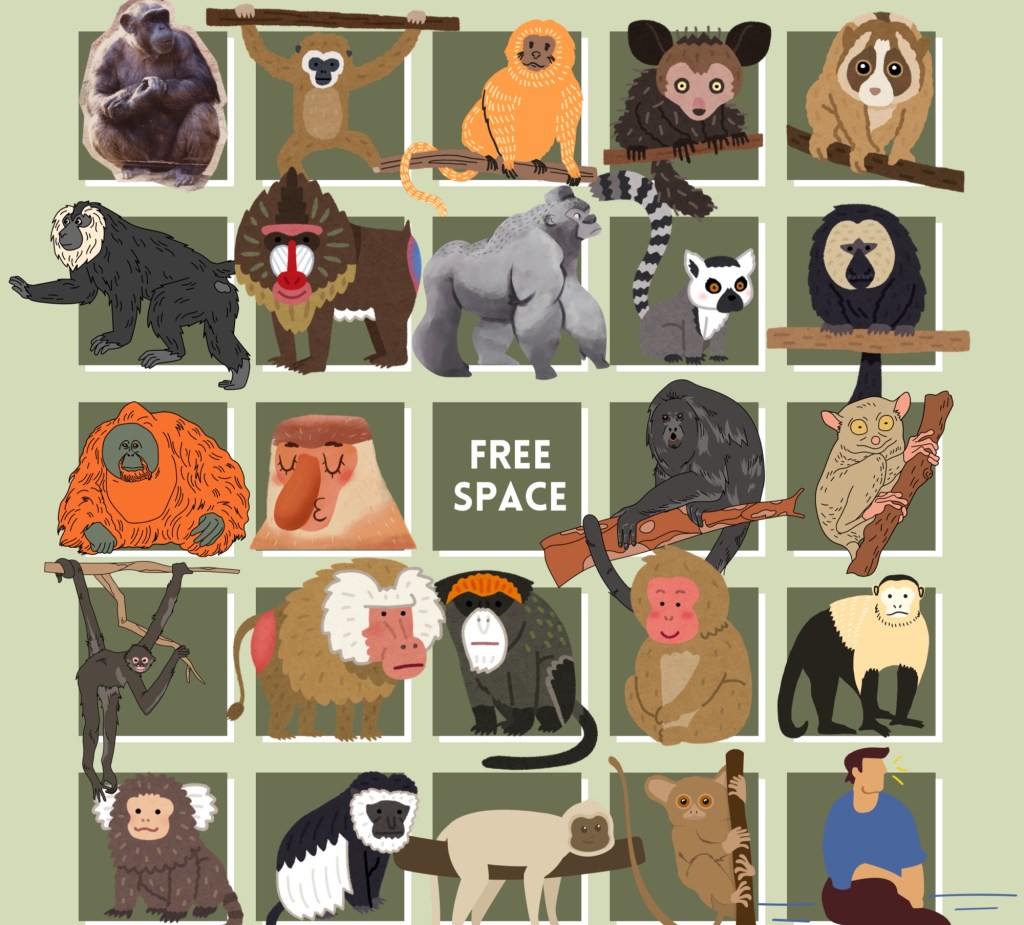
So, how do you as a teacher cover a large, varying group of primates efficiently and effectively? Primatology Bingo!
I developed this game in 2019 for Durham University’s Human Evolution and Diversity Module, then played around with the format in 2020 for the Supported Progression hominin evolution lecture.
Here are the rules:
1. Divide your students into small groups and provide them with different Primatology Bingo! cards.
2. Ensure that each group has access to a textbook, library database, Wikipedia, Google Scholar, or some combination of the above.
3. For each round, choose a trait at random from the list provided below. This list includes traits like quadrupedal, bipedal, brachiator, omnivorous, carnivorous, folivorous, monogamous, polygamous, arboreal, dimorphic, Old World, New World, no tail etc.
4. Students will then attempt to identify primate species that have the trait and determine if that primate is on their card. You can give them some guidance regarding which primates are featured on their cards if they have trouble seeing physical details in the illustration, but the more identification they do on their own, the better!
5. The first team to get 5 squares in a row must shout BINGO to win. But beware! The group that shouts BINGO first must present their findings to the class, and if they get something wrong, they are disqualified. Be open to new research and updated data! If the students present reliable evidence that a primate has a trait, even if it’s new or just a single study, give them the win.
You can make this game as difficult or as easy as you like by adjusting the specificity of the traits provided. Some traits (like quadrupedal, quad=four + ped=foot) will apply to most primate species on the bingo card. Others (like venomous) will only apply to one primate on the card above. By increasing the specificity of the traits, you can extend the length of the game. You can even send them on a wild goose chase to test their knowledge! For example, adding something like ectothermic (cold-blooded) to your list of traits will have them scratching their heads, as there aren’t any ectothermic primates. Be sure to encourage them to check their information with the textbook or database before answering.
I have provided 5 unique Primatology Bingo cards above, with a teacher card that includes the names of the primates and the list of traits you might use in each round. This should support 5 groups of 5 students playing the game in a typical Australian classroom. If your class is more than 25 (the USA maximum classroom capacity is higher, for example), or if you would like to divide into smaller groups, you can make your own cards in apps like Canva, or subscribe (for free) to the Brains and Bones website today!
Subscribers receive an additional 5 unique cards to use in their classrooms, plus our blogposts straight to your inbox.
 The Brains and Bones Project
Leave a comment