When was the last time your brain thought about itself?
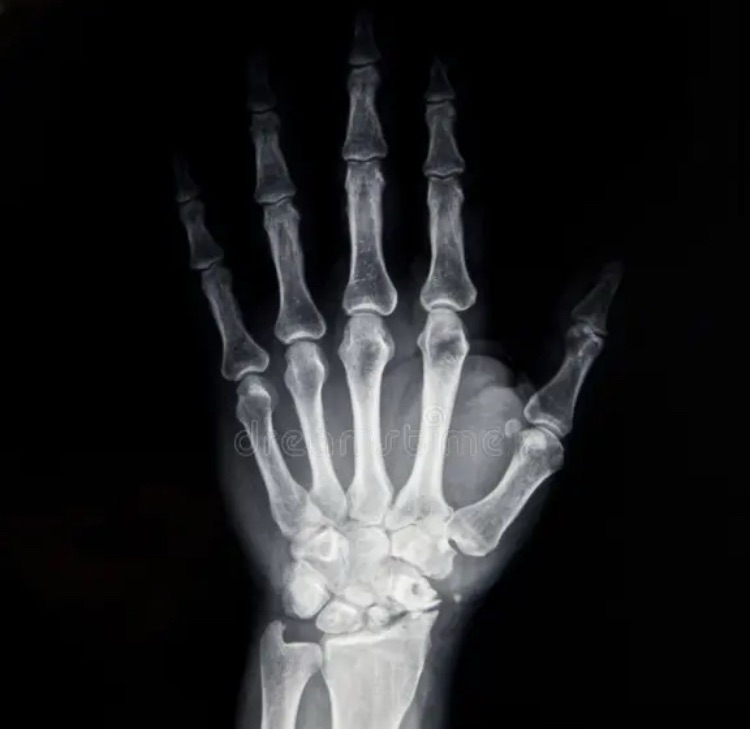
When was the last time you noticed your skeleton inside you?
It’s easy to forget that these parts of our bodies are intrinsic parts of ourselves. Our skeletons seem inorganic and passive; our thoughts seem separated from our physical bodies. But if our brains and bones are somehow not our bodies, then what are they?
Understanding your brain—and your thoughts and feelings—as physical parts of your body is called embodiment. And the cool thing about embodiment is that, once you start doing it, the boundaries of your brain start expanding. If your thoughts are part of your physical self, then your subconscious brain activity is part of your physical self, your nerve endings and the sensations they send to your brain are parts of your physical self, and your movements in response are all parts of your physical self! And if that’s the case, perhaps the opposite is then true. Perhaps our nerves, our muscles, and fingers are also parts of our brains and cognitive processes. Read more about embodiment here.
Some anthropologists argue that even the tools we hold in our hands become extensions of our brains and, therefore, extensions of ourselves. When I first heard this perspective from Professor Louise Barrett, a Visiting Fellow at Durham University at the time, I was struck by how well this explanation reflected a story I had heard from the Montana wildfire firefighters I had befriended in 2017. In a tragic incident, a group of firefighters perished when their leader told them to drop their trusted chainsaws and run. Those who followed the order survived. Those who didn’t could not bring themselves to drop the tools that had become emblematic of their identity as firefighters, even in the face of mortal peril. You can read more about this from Kansas City University here.
The above is a tragic example of what happens when we don’t acknowledge the embodied power of our tools. However, there is a positive power in this perspective as well. If we understand our cognitive processes, our bodies, and the tools we engage with as collectively, concomitantly ourselves, then new pathways towards understanding and acquiring knowledge emerge.
Barrett’s explanation of embodiment struck me in another way. Just like many in the Western world differentiate their thoughts from their physical bodies, a similar duality seems to creep into our bones as well. The skeleton is symbolic of death across time and place, and the chemical composition of our bones usually means that they will outlast the rest of our bodies for at least a little while. But this seems to have entrenched an understanding of our bones as something dead, passive, or, at the very least, inorganic. And this then draws a distinction between our living, autonomous bodies, and the skeletons within them. But our bones aren’t dead at all! Nor are they passive and motionless.
So, is there a way to re-imagine our brains and our bones as fundamentally embodied?
At the Brains and Bones Project, we certainly think so.
And we aren’t alone. Academics across the world are exploring the benefits of embodied teaching, which is the practice of reducing the mind-body duality that influences much of pedagogical practice. Programs across subjects that encourage movement, interactive activities, or tangible experiences are showing positive results for knowledge acquisition and post-test retention. Take a look at these studies from Physics, Literacy, and Environmental Science.
One additional benefit of an embodied approach for human anatomy and human evolution education is that the scientific concepts can be seen in our own bodies! So, not only is the teaching embodied, the data is embodied too. And—according to experts like Barrett—the interactive materials we use to supplement our teaching become embodied in the hands of our students.
Is there a way you’re using embodied teaching in your classroom? We’d love to hear your perspective. Email us through our Contact page today!


 The Brains and Bones Project
Leave a comment