This June, we were thrilled to participate in the Talks on Tuesday program in Melbourne. Attendees, which included adults of all academic backgrounds, had the opportunity to interact with our teaching skeleton and learn what makes humans so unique.
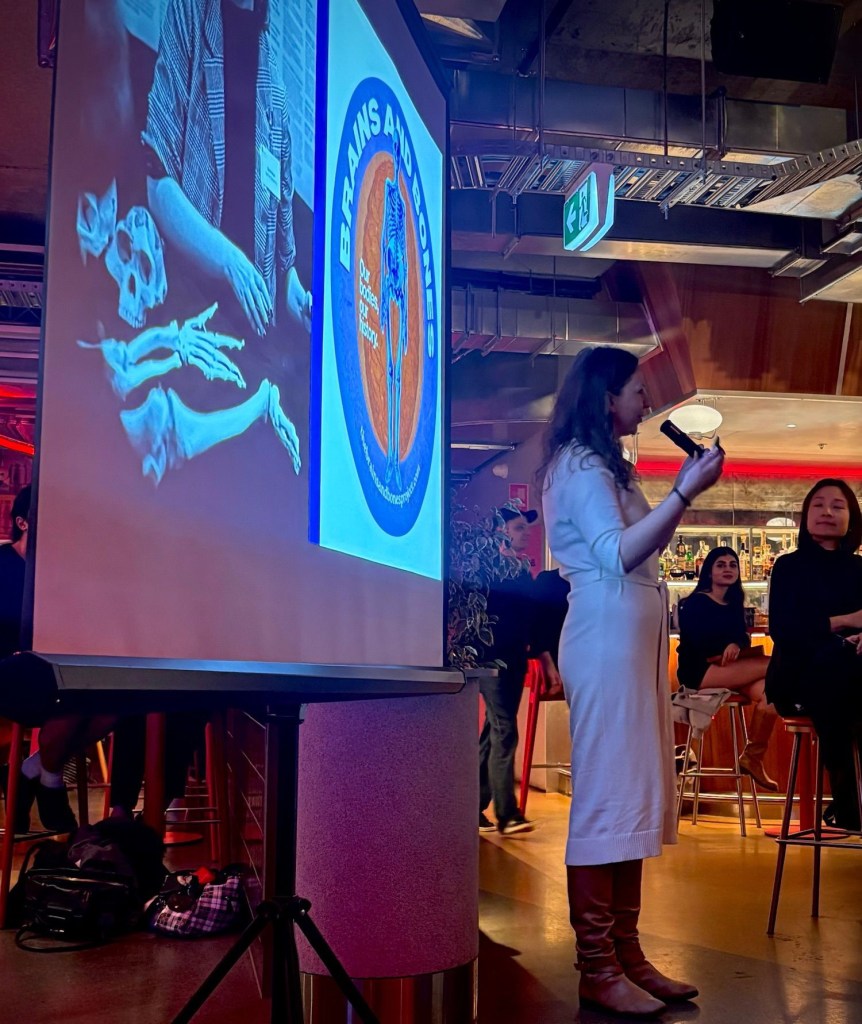
Many had terrific questions, demonstrating how deeply engaged they were with the material.
“How does the program engage with disability?”
“How do anthropologists make sure their work is anti-racist?”
“Can chronic mental illness appear in the skeleton too?
—just to name a few.
While I had to admit that I wasn’t aware of any research on chronic mental illness and the skeleton, I certainly had answers for the rest.
The short answer to these questions is self-reflection and empowerment. In anthropology, we use a relativistic and reflexive approach to data collection and analysis. We acknowledge that every lived experience is legitimate to the person actually experiencing it (even if it isn’t to us as observer), and that we (the anthropologists) are not empirical tools of measurement. We are as shaped by our own experiences and cultural expectations as everyone else. And if we lead with this self-awareness, plus a commitment to empowering participants, I believe this will take us far in our work towards equity and inclusion.
But, as an archaeologist, I can take this a step further.
The osteological paradox marked a major shift in our understanding of ancient disability and illness. Before this point, archaeologists had assumed that if they saw evidence of illness in a skeleton, then that individual must have been sick—and if they did not see evidence of illness in a skeleton, then that individual must not have been sick.
Seems pretty straightforward, right?
Here’s the problem: illness takes a very, very long time to appear in our bones. We must be chronically ill for this to happen, meaning these individuals must have survived with this illness long enough for it to appear in their skeletons. Whereas the skeletons we find without any evidence of illness at all were likely so acutely sick that they did not survive long enough for the illness to appear in their skeletons.
Health from an archaeological perspective is not ‘free of illness’ but rather resilient within the inevitability of illness. The individuals that we once thought of as ‘ill’ were likely the healthiest members of their community, because they were the ones that survived.
Thus, the disabled body is not an anomaly or abnormality, rather a manifestation of human resilience and equally important in an embodied paradigm. Every single person with a skeleton and a brain will experience their skeletons and brains inside of them. These experiences may look different than the experiences of others, but as we know from our relativistic approach, they are just as legitimate and worth exploring.
So, we hope you join The Project today, no matter what your brain or bones look like!


Leave a Reply